
How to level up your training when you’re ready for the next step
Many of the mums I train workout from home because its convenient, its much quicker, it supports their lifestyle BUT you can get to the point where you you perhaps might also wonder whether you’re doing enough with the equipment you have.
This blog will address the latest updated guidelines in strength and conditioning published in March 2026 and common queries mums have when they ‘graduate’ from my postnatal programs and they’re looking to keep up training from home.
How do I progress my lifts from home?
Training at home has its own doubts usually around whether it’s effective enough and the key to ensure it is is progressive overload! The latest guidelines in strength and resistance training published in March 2026 by the American College of Sports Medicine boasts a strong message of ‘consistency over complexity’. You dont need circus trick exercises, you just need to train all the main muscle groups regularly for progress to occur. So for those of you who enjoy a different workout every time you exercise…just be sure that you’re including a handful of the same movement patterns - squat, hinge, push, pull - to ensure that you’re hitting all the main muscles groups regularly, and not randomly.
To train well at home and progress your lifts over time you also don’t need a full squat rack or machines. The new guidelines point out that resistance and stimulus on the muscles can be from anything - be it resistance bands, bodyweight or free weights like dumbbells. Your body doesn’t know the load, it knows the tension, so if you’re pushing to fatigue with the weights you have and feel challenged…you will still benefit (I touch more on this later).
Ideally if you have a few different weight options, so either a selection of dumbbells (lighter and heavier) or adjustable weights it can be handy. Lower body movements will often require more reps to hit fatigue with lighter loads than upper body, hence having two or more sets can be helpful and allows you to scale exercises properly and hit muscular fatigue. For example, if you do squats with 2kg dumbbells you’ll likely have a high volume of reps vs. tricep kickbacks, you wont need nearly as many to hit fatigue with the same 2kgs, as they’re smaller muscles.
How do I know when I am ready to increase the weight?
This is where many women hesitate“how do I know if I’m doing enough or too much?” so without second guessing yourself, here is a simple framework you can follow:
Work within a rep range eg. 6-12 reps
When the top of that range feels manageable with good form… increase the weight next session
Expect the reps to drop slightly with the heavier weight, that’s normal
Build them back up over the next week within that rep range
Training to failure is no longer considered an effective way to train, but training to muscular fatigue is optimal. One of my favourite ways to hit fatigue is by leaving 1,2 or 3 reps in reserve. That means you should finish a set feeling like you could maybe squeeze out one or two more reps, but likely your form will go/failure. Then next time, you push for those 1-2 more and see if you can hit them! If strength if your goal, gains occur when you’re working close to fatigue/failure and hypertrophy (muscles growth) if you’re training a higher weekly volume of 10 sets.
By leaving 1–2 reps in reserve, you still challenge the muscle enough to grow stronger as you’re going close to failure (where you could perform no more!) but avoids unnecessary risk of injury, which is particularly important for women easing back into even heavier lifts.
This approach teaches you what real effort feels like in the muscles, without going to complete failure and wiping yourself out because at the end of the day, you still have to function for you and your loved ones!
Also keep these principles in mind - ‘The ABC of lifting’
Alignment - Prioritise your form before increasing the load. You always want to be getting the full range of motion in the exercise BEFORE you add more load. eg. you want a FULL squat down and up, not a half rep, before adding more load here
Breathwork - Can you breathe in a way that compliments your body? Using a brace technique or other way that helps lifting the weight feel more manageable and not bearing down or feeling light headed
Comfort- Stop if you feel pain (fatigue is normal, pain is not). Lunges and squats are not meant to make your knees hurt. Don’t push through it, change it and focus on the movement, not the load!
Track it!
One of the fastest ways to build confidence with your lifts is to see proof!
Write down the following for each workout:
The weight you used
The reps you achieved
How it felt - could you have done more, or do you need to take it down a notch?
When you repeat the week or look back overtime and realise the dumbbells that once felt heavy are now your warm-up weight… that’s where you can get huge confidence boosts!
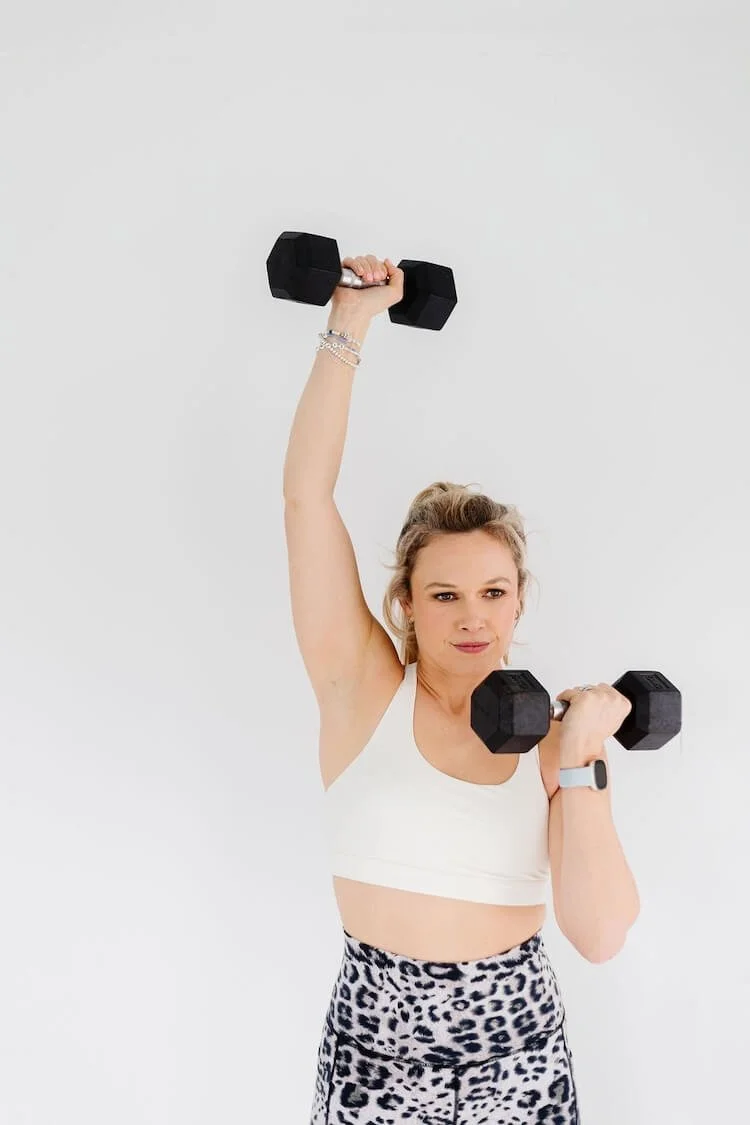
One of the biggest lessons in strength training (especially after kids) is understanding that progress isn’t always a straight line
Things to consider while lifting heavier and juggling being a mum…
This next step isn’t about avoiding heavy weights but it is about respecting YOUR body on the day of the workout and what challenges you might be up against that will limit your lifts.
As mums our routine can be thrown in any given moment, so consider changing it up when the following happens…
Sleepless nights
Felt delayed onset muscle soreness (DOMS) for a prolonged period of time after the last workout (more than 2-3 days
You aren’t well
The kids aren’t well - as you’re likely running around after them and burnt out
You’re feeling overwhelemed in general
You are running on empty
(you catch my drift…)
Then perhaps pushing yourself that week isn’t the answer…BUT all is not lost.
You can choose to lower the resistance or choose a lower energy workout. For example, the mums on The Advanced Postnatal Challenge and Let’s Lift (both included in The Fitness Hub membership) are given different Pilates workouts or 10 minute movers each week that compliments what they have been working on. Its perfect for the lower energy days, or if you’re shorter on time.
Progress your lifts gradually, not emotionally, and don’t let your ego take over and push through because you feel you ‘have to’. There will be weeks you lift less than before, and others you lift more. But strength gains are built over months, not days, so it’s about being consistent over time and having a plan that supports that.
Progress isn’t linear, and thats ok!
One of the biggest lessons in strength training (especially after kids) is understanding that progress isn’t a straight line. Some weeks you’ll hit new personal bests, and other weeks life will just get in the way.
Maybe the kids are sick, maybe your period is due or maybe you simply need a week off heavy lifts. That doesn’t erase the work you’ve already put in, it just means that particular day isn’t the day for pushing for max weight or extra reps.
Instead, focus on showing up in a way that works for your body and your schedule. Lower the weight, reduce the reps but showing up for you is what’s important. This is where a lot of the mums on my programs might choose a 10 minute workout fromThe Online Workout Channel (included in The Fitness Hub membership), a stretch and mobility session or a Pilates style workout so its not as intense and they can go back to their program when the moments of change have passed. They don’t just pack it in, they move in a different way that compliments how they’re feeling.
Every bit counts and keeping consistency, even if its 10 minutes a day a few times that week, is what builds long-term strength and confidence. Your body doesn’t know what movement you’re doing or load you’re lifting, but it knows if you’re not loading or moving purposefully at all! Remember: the goal isn’t perfection every day or every workout, it’s consistency over time!
Ready to bridge the gap between postpartum and beyond?
Let me introduce Let’s Lift
There’s a phase after the initial postpartum return to exercise (Step 1 in my 4 step process), then the few months after that where you’re establishing a strong exercise routine (Step 2 and Step 3), then there is the time after that where you feel you’re ready to level up…but not sure how to from home.
That’s the gap Let’s Lift was designed to bridge. To help you:
Increase resistance over time
Simplify tracking your progress
Build strength with structure
Feel supported by a community of other mothers at the same stage and phase, and a trainer that is here to support your goals and check in with you each week
If you’re ready to take that next step and really feel strong under load, Let’s Lift is designed for exactly this.
It’s a program you can follow from the comfort of your home via follow along video or do the written plan at your own pave, you can also bring it into the gym if you’re moving into that phase!
With every workout structured to help you progress safely, build strength, and track your gains this program gives you clear guidance and progression- all from home!
A strength training program designed for mothers who feel they're now ‘beyond’ the postpartum period and ready to confidently push their strength to the next level and train harder and smarter!
